
How long can ac run continuously?
How Long Can AC Run Continuously?
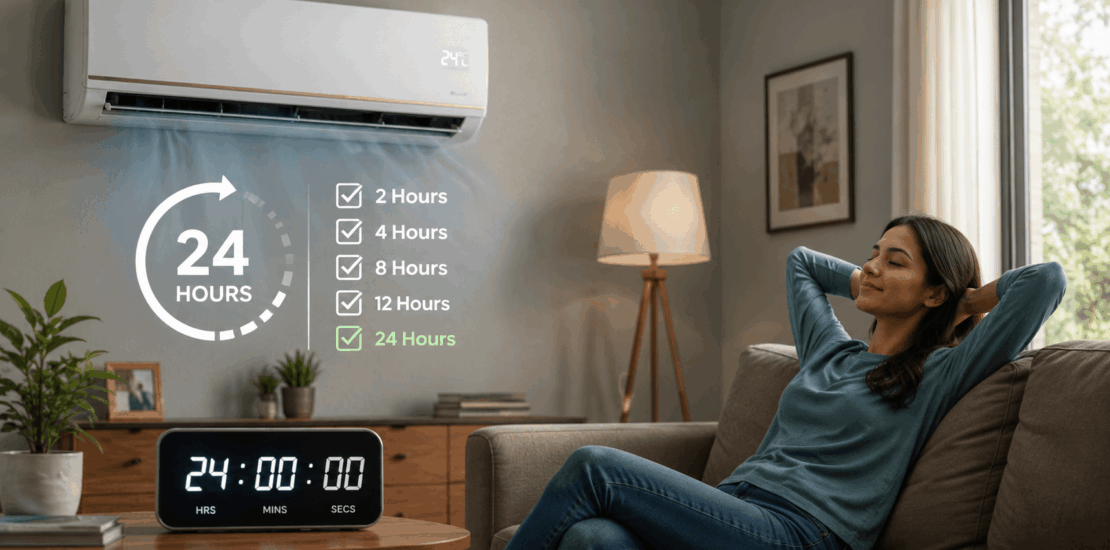
Yes, it’s safe for your AC to run continuously, and modern systems can run 24/7 indefinitely without breaking down. There’s no hard time limit — the real question isn’t “how long,” it’s “under what conditions,” since that determines whether continuous running is normal operation or a sign something’s wrong.
On a mild day, a properly working system cycles on and off — roughly 15 to 20 minutes running, then a break, repeating a few times an hour. Once outdoor temperatures push past 95°F, it’s completely normal for the system to run nonstop just to hold the temperature you’ve set, because heat is entering the house as fast as the AC can remove it. That’s the system working exactly as designed, not a malfunction.
Continuous Running vs. Short Cycling — Don’t Confuse Them
This is the distinction that actually matters, and it’s easy to mix up:
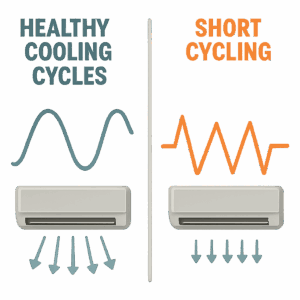
- Continuous running: the system runs nonstop for hours because it’s fighting intense outdoor heat to reach your thermostat setting. Normal, and not damaging on its own.
- Short cycling: the system turns on, runs for just a few minutes, shuts off, then restarts shortly after — repeating in a tight loop. This is damaging, and points to a real problem: an oversized unit, a faulty thermostat, or restricted airflow.
If your AC has been running for hours straight during a heat wave, that’s the first case, and it’s fine. If it’s turning on and off every few minutes all day, that’s the second case, and it’s worth investigating separately.
Why Continuous Operation Doesn’t Damage the Compressor
The compressor is the component people worry about most, understandably — it’s also the most expensive to replace. Here’s why running it continuously isn’t inherently risky: the compressor is bathed in cold refrigerant gas as it operates, which cools the motor while it runs. A properly charged system running at 100% duty cycle (on the whole time, no breaks) isn’t meaningfully more stressed than one cycling normally — as long as refrigerant levels are correct and the unit is otherwise well maintained.
On a moderately warm day, a healthy system typically has a duty cycle (the ratio of on-time to off-time) around 50-60% — something like 15 minutes on, 15 minutes off. During extreme heat, that can approach 100% without being a problem.
Also Read: Ac keeps running after temp is reached: Solutions & Tips
What Continuous Running Actually Costs You
Running nonstop is safe, but it isn’t free, and it does add wear over time — just not in the dramatic, sudden-failure way people often assume.
On your energy bill: A standard central AC draws around 3,500 watts. Running 24 hours at that draw is roughly 84 kWh a day; multiply by your local electricity rate to estimate cost — commonly landing somewhere in the $10-15/day range depending on your area, though your actual rate will move that up or down.
On lifespan: Running continuously today won’t break your system. But running it at or near 100% duty cycle constantly, season after season, does accelerate wear on the blower motor, contactors, and capacitors — the same parts that fail from normal aging, just sooner. A high-SEER, variable-speed system handles this much better than an older single-stage unit, since it’s specifically built to run continuously at low capacity rather than cycling at full blast.
Also Read: how to tell if ac compressor is bad?
Warning Signs It’s More Than Just Heat
Continuous running from heat alone shouldn’t come with these symptoms. If you notice any of them, something beyond the weather is going on:
- Weak airflow from the vents
- Warm air instead of cold
- Grinding, squealing, or rattling noises
- A utility bill spike well beyond what the heat alone would explain
Also Read: Does it cost more electricity to turn ac on and off?
Frozen coils are one of the more common results of continuous running combined with poor maintenance — a dirty filter or blocked vents restrict the airflow needed to keep the coil from getting too cold, and condensation on the coil freezes. Check and replace your filter every 30-60 days, more often during peak summer.
Condenser overheating is the outdoor equivalent — if the unit is clogged with dirt, leaves, or debris, the compressor can overheat and shut itself off. If the outdoor unit feels unusually hot or stops running on a very hot day: turn it off at the thermostat, let it cool for a few hours, and gently hose off the fins. If it trips the breaker or won’t restart, that’s a technician call.
Also Read: is it bad to turn ac on and off?
When Nonstop Running Means the Unit Is the Wrong Size
Sometimes continuous running isn’t about the weather at all — it’s about a unit that was never sized correctly for the home, often after an addition or a contractor’s rough estimate rather than a proper calculation.
- Undersized unit: runs nonstop, racks up energy costs, and still doesn’t reach the target temperature.
- Oversized unit: does the opposite — short-cycles instead of running continuously.
The only reliable way to confirm sizing is a technician performing a Manual J load calculation for your specific home, not a guess based on square footage alone.
Also Read: how long does an air conditioning unit last?
The Upside: Longer Cycles Mean Better Humidity Control
Continuous or long-cycle running isn’t purely a downside. Air conditioners remove both heat and humidity, but a system that only runs for a few minutes at a time doesn’t get enough time to pull real humidity out of the air — the room reads “cool” but feels clammy. Longer cycles extract more moisture, which is why a longer-running system on a humid day often feels more comfortable at 75°F than a short-cycling one does at 72°F.
How to Run Your AC Efficiently During Extreme Heat
Thermostat setting: The U.S. Department of Energy recommends 78°F when you’re home and cooling. Pairing that with ceiling fans keeps most people comfortable while meaningfully reducing compressor strain compared to a lower setting.
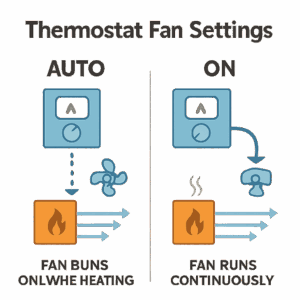
Fan mode — Auto vs. On:
- Auto: the fan only runs when the compressor is actively cooling. Better humidity control (moisture drains away instead of blowing back into the room), and lower energy use. Slightly less even temperature distribution between rooms.
- On: the fan runs continuously regardless of whether the compressor is cooling. Keeps hot spots more even and filters air constantly, but increases energy use and can reintroduce humidity into the air.
During peak summer, “Auto” is generally the better choice — better dehumidification and less wear on the blower motor.
Portable and window units work the same way but need slightly more attention: they can run 24 hours straight during a heat wave, but a brief 30-minute rest every 12-24 hours is good practice. More importantly, continuous running means continuous condensation — check the water collection tray or drainage hose regularly, since a full tray will trigger a safety shutoff on its own.
The Bottom Line
Your AC is built to run continuously when it needs to, and doing so during extreme heat isn’t a sign of trouble — it’s the system doing its job. What actually matters is maintenance: clean filters, clear vents and outdoor coils, correct refrigerant levels, and a properly sized unit. Keep those in order, and continuous operation costs you more on your energy bill during a heat wave, but it won’t cost you the system.