
Is Your Air Conditioner Not Blowing Cold Air But Running? Discover the Hidden Causes
Is Your Air Conditioner Not Blowing Cold Air But Running?
Before anything else: hold your hand up to a vent while the AC is running. That single check tells you which problem you actually have, and they have completely different fixes.
- Nothing coming out at all — this is by far the more common issue, and it’s almost always electrical, the blower motor, or something blocking airflow. Go to Part 1.
- Air is coming out, but it’s warm or barely cool — the blower is fine, the cooling process isn’t. This is a smaller, separate issue covered in Part 2.
Mixing these up wastes time — checking refrigerant levels won’t help if the real issue is a dead blower motor, and replacing a filter won’t help if the real issue is a refrigerant leak.
Part 1: Air Conditioner On But Not Blowing Air
If you don’t feel any air movement at the vents, the problem is almost always electrical, the blower motor, or something physically blocking airflow before it reaches the vents — not the cooling side of the system at all.
Quick answer: check the breaker first (takes 10 seconds), then the air filter (takes 2 minutes), then the blower fan itself if those check out.
| What you’re seeing | Likely cause | Fix |
| Thermostat display is on, but nothing happens at the unit | Tripped breaker or blown fuse | Reset breaker; if it trips again immediately, stop and call a technician |
| Unit hums or clicks but no air moves | Blower motor or capacitor failure | Technician repair |
| Weak trickle of air, not zero | Severely clogged filter or blocked return vent | Replace filter, clear the return vent |
| Air moves from some vents, not others | Blocked or closed dampers, disconnected ductwork | Check vents room by room; may need a duct inspection |
| Fan runs constantly but weak everywhere | Failing blower motor or worn belt (older systems) | Technician repair |
Check the breaker and thermostat first
Head to your electrical panel and look for a tripped breaker on the AC circuit. Reset it once. If it trips again right away, don’t keep resetting it — a breaker that won’t hold is protecting you from an electrical fault, and repeatedly forcing it back on risks damaging the system or starting a fire. That’s a technician call, not a DIY fix.
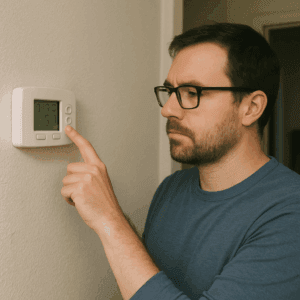
While you’re there, confirm the thermostat is set to “Cool” with the fan on “Auto,” not “On” — both settings will run the fan, so this rarely explains zero airflow, but it takes five seconds to rule out.
Check the filter and return vent
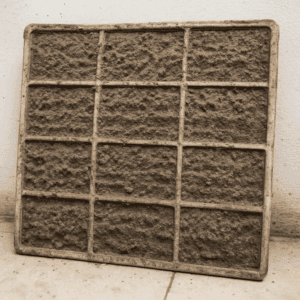
A severely clogged filter can restrict airflow enough that it feels like almost nothing is coming out, even though the blower is technically running. Pull the filter and hold it up to a light — if you can’t see light through it, replace it. While you’re there, make sure the return air vent (the larger vent that pulls air into the system, usually with no visible ductwork attachment at the grille) isn’t blocked by furniture or a closed door.
If it’s still not moving air
At this point the issue is almost always the blower motor, its capacitor, or a break somewhere in the electrical path to it — none of which are safe or practical to diagnose without opening the unit and testing components with the power off.
A specific pattern worth knowing: if the thermostat display is lit up and the outdoor unit is running (you can hear or feel it), but there’s still no air from the vents, that points squarely at the blower motor or its capacitor — the outdoor half of the system (compressor, condenser) and the indoor half (blower) run somewhat independently, so it’s entirely possible for one to work while the other doesn’t. A failing blower capacitor often shows up as a faint humming sound from the indoor unit with no actual air movement, similar to how a compressor capacitor fails outside. This is a same-day repair for a technician and one of the more affordable fixes on this list — but not a safe DIY job, since the capacitor holds a charge even with the power off.
If instead the outdoor unit isn’t running at all — no sound, no vibration — go back to the breaker. That’s a stronger sign of a full power interruption than a blower-specific fault.
Also Read: Essential AC Repair Tips for Homeowners
Part 2: Air Is Moving, But It’s Not Cold
If air is coming out of the vents but it’s warm, lukewarm, or only slightly cool, the blower is working fine — the problem is somewhere in the cooling process itself: the thermostat, the refrigerant, the evaporator coil, or the outdoor condenser.
Quick answer: the most common causes, in order of how often they turn out to be the issue, are a dirty air filter restricting airflow across the coil, a dirty outdoor condenser, low refrigerant from a leak, and a frozen evaporator coil (which is usually a downstream symptom of one of the first two).
A useful benchmark: air coming out of your vents should be roughly 15–20°F colder than the air going into the return vent. If you don’t have a thermometer handy, feel the difference between the air at a supply vent and the air near the thermostat — a large, obvious difference means the system is cooling correctly even if the room doesn’t feel cold yet (which usually points to sizing or insulation). Almost no difference means the cooling process itself isn’t working.
| What you’re seeing | Likely cause | DIY or pro? |
| Barely any temperature difference at the vent | Refrigerant issue or compressor problem | Pro |
| Weak airflow and warm air | Dirty filter or dirty condenser restricting the whole system | DIY — check filter first |
| Hissing sound from the outdoor unit | Refrigerant leak | Pro |
| Ice visible on the indoor coil or refrigerant lines | Frozen coil — from airflow restriction or low refrigerant | Turn off the system, let it thaw, then check the filter |
| AC runs constantly, never quite gets there | Undersized unit, poor insulation, or a dirty condenser under heavy load | Check condenser first; sizing needs a technician |
| Cools fine for a while, then tapers off warm | Ice building up mid-cycle on the coil | Same as frozen coil above |
Start with the filter and thermostat
Same first move as Part 1: a dirty filter restricts airflow across the evaporator coil, and less airflow across it means less heat gets absorbed from your home’s air, so what comes out the other side is warmer than it should be. While you’re checking it, confirm the thermostat is set to “Cool” and the target temperature is actually below the current room temperature — an easy thing to overlook.
Check the outdoor condenser
The condenser is what actually releases the heat your system pulls out of your home. If it’s caked in leaves, grass clippings, or dirt, it can’t dump heat efficiently, and the whole system loses cooling capacity even though everything else is working. With the power off at the breaker, clear debris from around the unit and rinse the coil fins with a garden hose from the inside out — never a pressure washer, which can bend the fins. If cooling doesn’t improve after a clean and the system still runs warm, move to refrigerant.
Frozen evaporator coil
Ice on the coil is a symptom, not a root cause — it happens because airflow was restricted (dirty filter, blocked vents) or refrigerant was already low, either of which lets the coil get cold enough to freeze the moisture in the air around it. Turn the system fully off (not just the thermostat) and let it thaw for a few hours before doing anything else — running it with ice on the coil just adds strain. Once thawed, replace the filter and try again. If it refreezes within a day or two, the underlying cause is refrigerant, not the filter.
Refrigerant leaks
Weak or no temperature difference at the vent, combined with a hissing sound from the outdoor unit or ice on the refrigerant line (not the coil itself), points to low refrigerant. This isn’t a level that gets “topped off” like motor oil — if it’s low, something is leaking, and simply adding more without finding and sealing the leak just delays the same problem. This is licensed-technician territory; handling refrigerant also requires EPA certification.
Undersized unit or poor insulation
If the temperature split at the vent is fine (that 15–20°F difference) but the room still doesn’t feel cold, the cooling process is working — the house just can’t hold onto the cold air. That points to insulation, air leaks around windows and doors, or a unit that’s simply too small for the square footage. None of these are things a filter change or coil cleaning will fix; they need a home energy assessment or a technician’s load calculation.
Also Read: Winter thermostat settings
When to Stop Troubleshooting and Call Someone
Stop and call a professional air conditioner repair experts if any of these are true, regardless of which part above you’re in:
- A breaker trips more than once when reset
- You hear hissing, which almost always means refrigerant
- The unit has run with a frozen coil or in a fault state for more than a day
- You’ve gone through the filter, vents, and (for Part 2) the condenser, and nothing changed
Running a system that isn’t cooling correctly doesn’t just leave you uncomfortable — it puts extra strain on the compressor, which is the single most expensive component to replace. A day or two of troubleshooting is reasonable; continuing to run it for a week hoping it self-corrects usually turns a cheap fix into an expensive one.

Preventing Both Problems
Most of what’s above traces back to two things: airflow and refrigerant. Regular upkeep catches both before they cause a breakdown:
- Replace the air filter every 60–90 days
- Rinse the outdoor condenser clean at the start of cooling season and keep the area around it clear
- Schedule an annual refrigerant and electrical check-up before summer
- Keep vents open and unobstructed, and check ductwork after any renovation or furniture rearranging