How to Clean a Coil on AC: Step-by-Step Guide for Homeowners
How to Clean a Coil on AC: Step-by-Step Guide for Homeowners
Your air conditioner works hard to keep your home cool and comfortable. But when the coils get dirty, your AC has to work even harder. You may ask, “How to clean a coil on AC?” Well, the answer is easier than you might think, and it saves you money on energy bills. Dirty coils make your AC less efficient and can even cause it to break down. With the right tools and a little time, you can clean your AC coils yourself and keep your system running smoothly.
AC coils are an important part of your air conditioning system. They help remove heat and moisture from your home. Over time, dust, dirt, and debris build up on the coils. This buildup blocks air from flowing through properly. When air can’t flow, your AC can’t cool as well. Many homeowners ask, “How to clean AC evaporator coils inside house?” The answer is that this is something that can be done without calling a professional. It’s a simple maintenance task that takes just a couple of hours.
Understanding AC Coils and Why They Matter
What Are AC Coils?
AC coils are metal tubes inside your air conditioning system. They look like a car radiator with thin metal fins. Two different types of coils work together in your system. One is the evaporator coil, and the other is the condenser coil. The evaporator coil is inside your home, usually in your furnace or indoor unit. The condenser coil is outside. Both types can get dirty and need cleaning.
The Science Behind Coil Fouling
Research from Lawrence Berkeley National Laboratory demonstrates that the average coils become dirty enough to double evaporator pressure drop in just 7 to 11 years, far earlier than the 15- to 30-year life of an evaporator coil. It also pointed out that, although reduced airflow due to coil fouling usually produces less than 5% efficiency and capacity loss, this can be much worse in marginal systems or extreme conditions.
Types of AC Coils in Your System
- Evaporator Coils: These are inside your home. They absorb heat from the air in your rooms. Dust and pet hair easily stick to these coils because air passes through them constantly.
- Condenser Coils: These are in the outdoor unit. They release the heat your AC pulled from your home. Dirt, leaves, and grass clippings stick to the outside coils.
Both coils need cleaning to keep your AC working well. When you know how to clean AC evaporator coils, you’re helping your entire system run better.
Why Cleaning AC Coils Is Important
Coils are the lungs of your air conditioner. Poor breathing will be the result of clogged lungs. Dirty coils hinder the cooling ability of your AC. Better cooling, lower energy bills, and a more efficient system can exist due to clean coils.
Benefits of Keeping Your AC Coils Clean
- Lower Energy Bills: A clean air conditioning unit uses less electricity. Dirty coils put extra pressure on your system and make it cost you more each month.
- Better Cooling Performance: Cleaner coils mean your home cools faster, and the coldness stays in your home longer.
- Longer System Life: A well-maintained AC system lasts longer. When the coils are dirty, it causes your system to overwork and wear out.
- Fewer Repairs: Routine cleaning can prevent a lot of malfunctioning issues.
- Healthier Air Quality: Clean coils mean cleaner air in your home. Dust and allergens don’t build up as much.
Consequences of Skipping Coil Maintenance
Ignoring dirty coils leads to real problems:
| Problem | What Happens |
| Reduced cooling | Your home stays warmer than it should |
| Higher bills | Your AC uses more electricity |
| Ice buildup | Frozen coils can damage your system |
| Strange smells | Mould grows on dirty, damp coils |
| System breakdown | Your AC might stop working completely |
| Expensive repairs | Neglect can lead to costly professional fixes |
| Compressor wear | Abnormally low suction pressures stress internal parts |
Also Read: How to stop condensation on air vents
Additional Impact (System-Wide Effects):
| Area Affected | Impact |
| Compressor | Wear due to abnormally low suction pressures |
| Refrigerant components | Repeated ice formation causes stress |
| Water system | Condensate overflow can lead to water damage |
| Indoor air quality | Biological growth spreads spores and bacteria through the air |
How Often Should You Clean Your AC Coils?
Recommended Cleaning Schedule
Homeowners should clean evaporator coils every one to two years. Condenser coils must be cleaned 1-2 times a year. These are general rules, but you might be an exception. The ENERGY STAR program flags this task for the highest priority: coil cleaning before warm weather starts is one of the most impactful maintenance tasks for keeping rated HVAC efficiency.
Factors That Affect How Often You Clean
- Pets in the home—pet hair clogs coils faster, so clean more often
- Dusty environment—if you live in a dusty area, clean more frequently
- Climate—hot climates make AC work harder, causing faster buildup, and longer cooling seasons mean more total fouling accumulates per year
- System age—older systems may need more frequent cleaning
- Filter quality—good air filters slow down coil buildup; research shows filter efficiency is one of the most important variables in how fast a coil fouls
- Usage—if you run your AC constantly, coils get dirty faster
If you have pets or live in a dusty area, plan to clean your coils every six to twelve months. Regular cleaning keeps everything running smoothly.
Also Read: is mold in ac unit dangerous
Tools and Materials You’ll Need
Essential Coil Cleaner Products
- Commercial Coil Cleaner Spray: This is the easiest option for most homeowners. Coil cleaner spray is made specifically for AC coils. You spray it on, let it sit, and rinse it off. Look for cleaners that work on both evaporator and condenser coils. Most cost between ten and thirty dollars.
- Foam Coil Cleaner: This comes in a can and expands like foam. It covers the entire coil surface and breaks down dirt effectively. Foam cleaners are great for heavily soiled coils.
- Alkaline Coil Cleaner: This is stronger than regular spray. Use it for thick, stubborn dirt buildup.
Other Tools and Supplies You Need
- Fin comb — straightens bent fins on coils
- Soft-bristled brush — gently scrubs coils without damaging them
- Vacuum with brush attachment — removes loose dust before cleaning
- Water spray bottle or garden hose — rinses off cleaner
- Goggles—protect your eyes from cleaner spray
- Gloves — protect your hands from chemicals
- Towels or rags — for cleanup
- Screwdriver — removes panels and covers
- Flashlight — helps you see inside the unit
Also Read: Air conditioner struggling to cool house
Step-by-Step Guide to Clean AC Coils
Step 1: Prepare Your AC Unit Safely
- Turn off your air conditioner completely. Don’t just turn it to off mode. Switch off the breaker in your electrical panel. Safety comes first. Wait five minutes to make sure power is completely off.
- Locate your AC unit. For evaporator coils, find your furnace or indoor AC unit. For condenser coils, go to your outdoor unit.
- Take photos before you start. Photograph the setup so you remember how to put everything back together.
- Let everything cool down. Wait at least thirty minutes after shutting off your AC so nothing is hot.
Step 2: Remove Covers and Access the Coils
- Find the access panel. This is usually held on with bolts or clips. You might need a screwdriver to remove it.
- Take off the panel carefully. Keep all bolts and screws in a safe place so you don’t lose them.
- Use your vacuum first. Before spraying any cleaner, vacuum away loose dust and dirt. This makes the cleaner work better. Use the brush attachment so you don’t scratch the fins.
- Inspect the coils. Look at them with your flashlight. You’ll see how dirty they are. Don’t worry if they look pretty grimy. That’s normal.
Step 3: Clean Evaporator Coils Inside Your Home
- Spray the coil cleaner evenly. Start at the top and work your way down. Make sure the cleaner covers the entire coil. Don’t spray too much. The cleaner should soak in, not run off immediately.
- Let the cleaner sit. Read the instructions on your cleaner can. Most need five to fifteen minutes to work. This soaking time breaks down dirt and buildup.
- Use a soft brush gently. If dirt is stubborn, use a soft-bristled brush to gently scrub. Never use a hard brush or steel wool. These damage the delicate fins.
- Spray with water to rinse. Use a spray bottle or garden hose with low pressure. Let water rinse the cleaner and loosened dirt away. Catch the dirty water with towels if you’re inside.
- Check the drain pan. Dirty water drains into a pan under the coil. Make sure this pan is clear and draining properly. If it’s clogged, clean it out.
Step 4: Clean Condenser Coils on Your Outdoor Unit
- Clear the area first. Remove leaves, grass, and debris from around the outdoor unit.
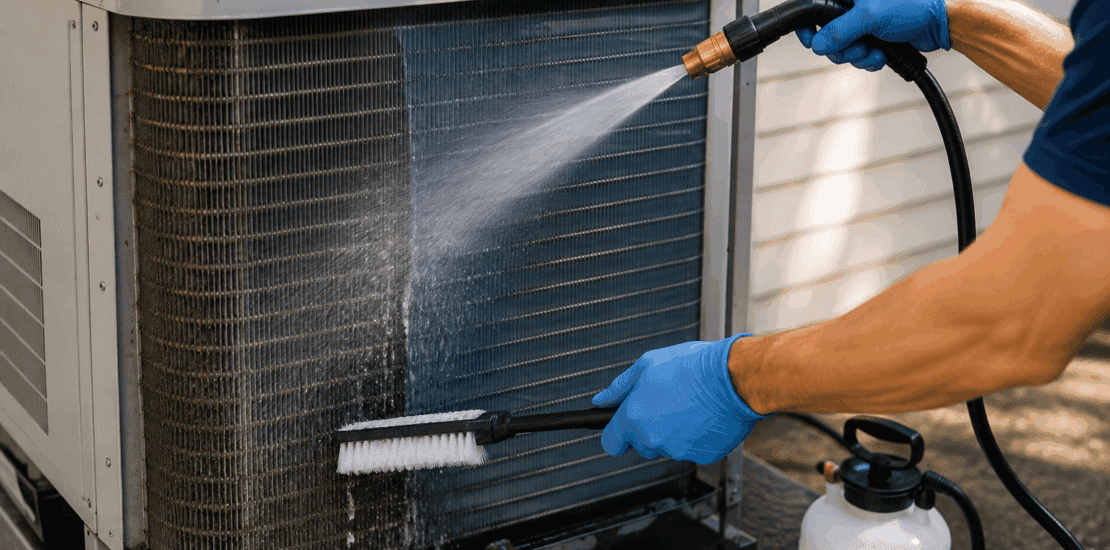
- Spray the coil cleaner. Use the same spray technique as the indoor coils. Start at the top and work down. Spray in the direction of the fins.
- Let it soak for the recommended time. Most cleaners need five to fifteen minutes.
- Completely wash with a garden hose. Use low pressure to avoid damaging the fins. Wash from top to bottom. Make sure the cleaner and dirt wash away entirely.
- Always inspect the fins after rinsing. Carefully comb bent fins to straighten them. When cooling systems are impacted by airflow issues, bent fins are often to blame.
Step 5: Final Steps & Reassembly
- Let everything dry out. Only reuse the AC after waiting for at least an hour.
- Check all bolts and screws. Make sure everything is tight before you power up the system.
- Replace all covers and panels. Put back the access panels and secure them tightly.
- Restore power to your AC. Switch the breaker back on and turn your AC unit back on.
- Run the system briefly. Let it run for ten to fifteen minutes. Listen for any unusual noises ac making. Feel the air coming out. It should feel cooler and stronger than before.
Also Read: How to repair heating and air conditioning
An Important Safety Note on Refrigerant Lines
It is not necessary to open the sealed refrigerant loop for coil cleaning, and homeowners should never do so. According to federal law, EPA regulations under Section 608 of the Clean Air Act govern the handling and recycling of refrigerants in stationary air conditioning and refrigeration equipment. A person can only recover, charge, or access refrigerant (in any way) if they are certified under EPA Section 608. Otherwise, you can get fined. If you see oily residue around the refrigerant lines associated with cleaning jobs, you should take that as a signal to call a licensed technician and not investigate it further yourself.
When to Call a Professional Instead
Signs You Need Expert Help
- Refrigerant leaks: If you see oil stains near the outdoor unit, you might have a refrigerant leak. This requires a licensed technician.
- Severely damaged fins: If many fins are bent or broken, a professional should replace the coil.
- Ice on the coils: If ice builds on the coils after you reset the refrigerator, this is a warning sign.
- Strange sounds or smells: Unusual noises and odours point to serious trouble that can only be diagnosed professionally.
- System not cooling after cleaning: If your system has been cleaned but is not cooling, it means there is something wrong.
- Electrical concerns: If you’re uncomfortable working with electricity, call a professional.
- Central AC systems: These are more complex than window units. If you’re unsure, hire a profession hvac technician.
When Professional Cleaning Services Are Worth It
Professional AC cleaners have special equipment that reaches every part of the system. They can clean more thoroughly than homeowners can. If your coils are extremely dirty or your system is complicated, professional service might be worth the cost. Professional cleaning usually costs between one hundred fifty and three hundred dollars, but it can extend your AC’s life and improve efficiency significantly.
Keep Your AC Running Cool and Efficient with COOL-AID CO.
At COOL-AID CO., we make it easy for homeowners to keep their HVAC working in its best condition. One of the easiest ways to boost performance is to clean your AC coils, and we will help you with that process. Whether you need expert advice, a professional clean, or the right products, we take the hassle and confusion out of your project. Clean coils will lead to better cooling and a small energy bill. It also increases the duration of your device.
When you have the right support, regular maintenance is extremely easy to do. At COOL-AID CO., we can help you avoid costly repairs by keeping your current system clean and running efficiently. We provide trustworthy air conditioner inspections and cleaning services that help your AC perform like new. With our assistance, you can achieve uniform comfort, enhance efficiency, and have peace of mind knowing your system is in good hands.