
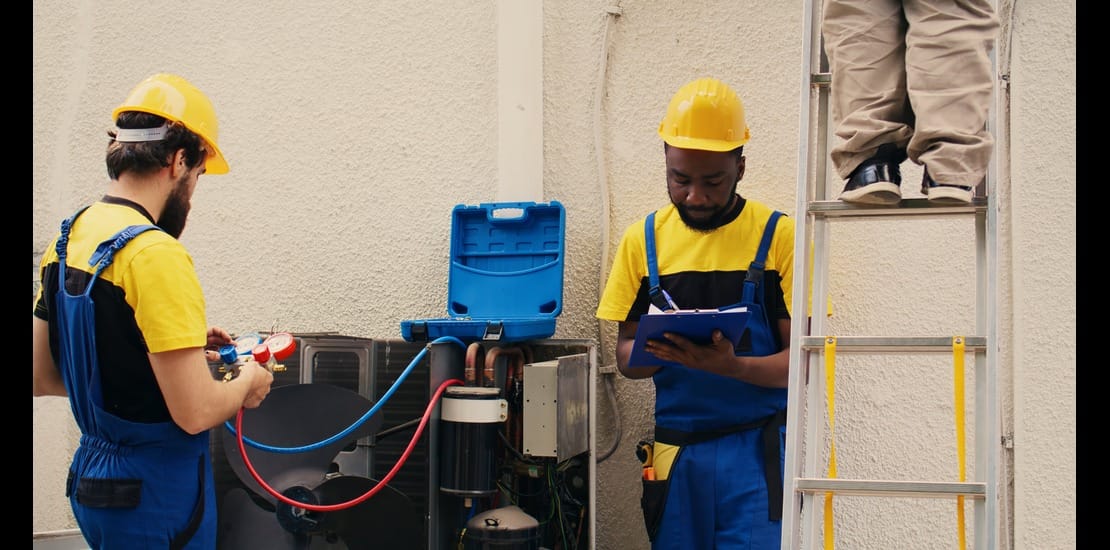
Can an AC Compressor be Repaired?
Can an AC Compressor be Repaired?
Yes — most common AC compressor problems can be repaired without replacing the whole unit. A bad capacitor, a worn contactor, a refrigerant leak, or dirty condenser coils are all standard repairs for a licensed HVAC technician. What usually can’t be repaired is internal mechanical damage — a seized compressor, burned-out motor windings, or a cracked casing — where replacement is the only real fix.
The compressor is what moves refrigerant through your system and pushes heat out of your home. When it fails, your AC either stops cooling completely or runs noticeably worse. Whether repair makes sense comes down to two things: what specifically failed, and how the repair cost compares to replacing the unit outright.
Usually repairable:
- Failed capacitor or relay
- Bad contactor
- Loose, frayed, or corroded wiring
- Refrigerant leak (once found and sealed)
- Dirty condenser coils or contamination in the system
- Compressor that shuts off from overheating (sometimes just needs a reset)
Usually not worth repairing:
- Seized or jammed internal components
- Burned-out motor windings
- A cracked or leaking compressor casing
- A unit already 10–15 years old
- Repair cost approaching 50% of a new unit’s price
How to Tell Which One You Have
Symptoms overlap a lot here, which is exactly why people sometimes pay for a diagnostic call and end up hearing “you need a whole new unit” when the fix was actually a $150 part. Here’s how the most common symptoms map to cause and repairability:
| What you’re seeing | Likely cause | Repairable? |
| AC clicks but won’t start | Failed capacitor or bad contactor | Yes — usually $100–$350 |
| Warm air from the vents | Refrigerant leak, or compressor motor failure | Depends — leak is repairable, motor failure often isn’t |
| Breaker keeps tripping | Electrical fault (wiring, contactor, or motor short) | Sometimes — needs diagnosis to know which |
| Loud clanking or rattling | Loose or worn internal parts, debris in the unit | Rarely — usually points to internal damage |
| Compressor hums but doesn’t start | Weak capacitor, or a mechanically seized compressor | Sometimes — capacitor is cheap to rule out first |
| System shuts off, restarts fine after 30–60 min | Overheating, often from dirty coils or low refrigerant | Yes — but treat it as a warning sign, not a fix |
| Compressor won’t run at all, multimeter shows open winding | Burned-out motor | No — replacement |
he fastest way to use this table: if a technician tells you the compressor needs replacing, ask specifically which of these it is. “The motor winding tested open” is a different situation than “it’s probably the compressor” — the first is a confirmed diagnosis, the second is a guess that’s worth a second opinion.
Also Read: is my ac compressor failing
The 50% Rule
Even when something is technically repairable, it isn’t always worth repairing. The rule of thumb HVAC technicians use: if the repair cost approaches half of what a new unit would cost, replacement is usually the better value, since you’d be sinking money into an aging system that could fail again soon after.
Rough national ranges for common repairs:
| Repair | Typical cost |
| Capacitor replacement | $100 – $300 |
| Contactor replacement | $150 – $350 |
| Refrigerant leak repair + recharge | $200 – $600 |
| Full compressor replacement | $1,200 – $2,800 |
(These are general U.S. averages and vary by region and unit — get a local quote before deciding.)
A full compressor replacement alone can land close to the cost of a new system, which is why a compressor-specific quote is worth comparing against a full-system replacement quote before committing to either.
Common Repairable Issues, Explained
Capacitor or relay failure. The capacitor gives the compressor motor the jolt of power it needs to start. A failing one causes the unit to hum, click, or attempt to start without actually running. Warning signs on the part itself: a bulging or swollen top, leaking fluid at the base, or burn marks. Replacement needs to match the exact voltage and microfarad rating of the original — this is a same-day fix for most technicians, and one of the cheapest repairs on this list.
Contactor failure. The contactor controls power flow to the compressor. A bad one produces a telltale symptom: the unit clicks like it’s trying to start but nothing happens, sometimes with visible burn marks on the contactor itself. Straightforward swap, usually inexpensive.
Wiring issues. Loose, frayed, or corroded wiring causes intermittent power loss to the compressor. A technician tests continuity and replaces the damaged sections.
Refrigerant leaks. Low refrigerant forces the compressor to work harder to move heat, which causes overheating and shutdowns. The fix isn’t just “add more refrigerant” — a technician needs to locate and seal the leak first, then recharge the system to the correct level. This requires EPA certification to handle legally, so it isn’t a DIY repair regardless of how simple the actual recharge looks.
Contamination. Dust, debris, or moisture inside the system degrades compressor performance over time. A professional flush and clean resolves it if caught before it causes lasting damage.
Overheating shutdowns. Most compressors have a built-in safety cutoff. If yours shut off and you want to try a reset before calling anyone: switch the system off at the thermostat and the breaker, wait 30–60 minutes, then restart. If it runs normally afterward, the shutdown was likely a one-off. If it overheats again shortly after, the reset didn’t fix anything — it just delayed the real problem, which is usually restricted airflow, low refrigerant, or an electrical fault underneath.
Also Read: how to repair heating and air conditioning
When It’s Not Repairable
- Internal mechanical failure — broken pistons, bearings, or valves inside the compressor are not designed to be serviced individually. Replacement is the only option.
- Burned-out windings or a short to ground — testable with a multimeter at the compressor terminals (set to ohms, check continuity between the C, R, and S terminals, then each terminal to the compressor’s metal body). No reading, or a reading where there shouldn’t be one, means the motor is done.
- Cracked or damaged casing — this compromises system pressure directly and can’t be sealed reliably.
- Old refrigerant type — older systems using R-22 (phased out) can’t legally be recharged with it anymore, which sometimes makes compressor repair pointless if the rest of the system is also aging out.
- Unit is 10–15+ years old — this is the average lifespan of a compressor with normal maintenance. Past that point, a repair on one part often just exposes the next part that’s close to failing too.
Can You Repair It Yourself?
Some of this you can safely check. None of it, past checking, is something to attempt without training.
Safe to do yourself:
- Visual inspection of the capacitor for bulging, leaking, or burn marks
- Cleaning debris away from the outdoor unit
- Rinsing condenser coils with a garden hose (power off first)
- The 30–60 minute overheating reset described above
Not a DIY job, even if it looks simple:
- Anything involving refrigerant — handling it without EPA certification is illegal, not just risky
- Capacitor replacement — these hold a dangerous electrical charge even when the unit is unplugged
- Any wiring or internal electrical work
- Multimeter testing on live components — this needs the power fully cut at the breaker first, and misreading a test can lead to a wrong (and expensive) part swap
A misdiagnosis costs more than the technician’s visit would have — either from replacing a part that wasn’t actually the problem, or from a bad DIY repair damaging a part that was still working fine.
Also read: Air conditioner not blowing cold air but running
Preventing Compressor Failure
Most of the causes on this page — overheating, refrigerant loss, contamination — build up slowly and are preventable with basic upkeep:
- Clean or replace air filters every 60–90 days
- Keep the outdoor unit clear of leaves, grass clippings, and debris
- Rinse condenser coils at the start of each cooling season
- Schedule an annual refrigerant and electrical check before summer
The Bottom Line
Most AC compressor problems — capacitors, contactors, wiring, refrigerant leaks — are repairable, usually for a few hundred dollars. Internal mechanical failure, a damaged casing, or a unit already past its expected lifespan usually isn’t worth repairing once you weigh the cost against a full replacement.
If you’re not sure which situation you’re in, the diagnostic table above is a starting point — but a proper diagnosis from a licensed technician is the only way to know for certain before you spend money either way. If you’d like a second opinion or a straight answer on repair vs. replace, the team at Cool Aid Co. can take a look.