
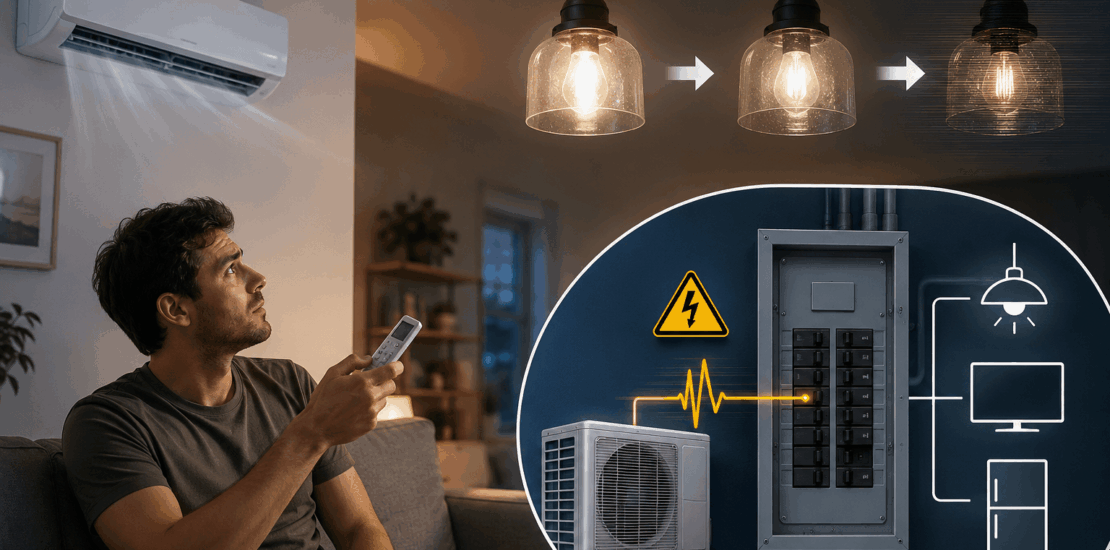
Why do my lights flicker when my ac turns on
Why do my lights flicker when my ac turns on
A quick dim for a second or so when your AC starts is common. The compressor draws several times its running current for a moment, which briefly lowers the voltage available to your lights. It becomes a problem when it’s strong, lasts, or comes with other signs. Use the table to see which you have.
Don’t open your electrical panel or touch wiring to investigate. This page covers what you can safely check and who to call.
How Bad Is It?
| What you see | What it likely means | What to do |
| One brief dim as the AC starts, then normal | Normal startup surge | Nothing needed |
| Lights dim noticeably every time, across much of the house | A big surge on a weak spot: a struggling compressor or failing capacitor, undersized wiring or panel, or the utility side | Call an HVAC technician first, then an electrician if it continues |
| Only lights on the same circuit as a window or portable AC flicker | That circuit is overloaded or the voltage drops too much | Plug the AC into its own circuit. See the safety note below. |
| Some lights get brighter while others dim | Possible loose neutral connection | Stop using heavy appliances and call an electrician or your utility today |
| Flicker with buzzing, a burning smell, warm or discolored outlets, or a tripping breaker | Electrical fault | Turn the AC off and call an electrician. For smoke or a strong burning smell, leave and call 911 |
| Neighbors’ lights flicker too, or it happens with the AC off | Utility or grid problem | Call your utility |
| One fixture flickers, AC off | Bulb, fixture, or dimmer | Replace the bulb or dimmer |
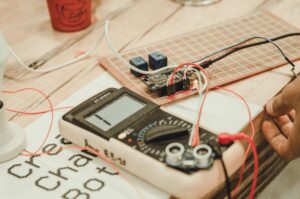
by Shirish Suwal (https://unsplash.com/@shirishsuwal)
Why It Happens
A compressor motor needs a big burst of current to start. Estimates for that surge run from 3 to 10 times the running current, depending on the motor. That burst pulls the voltage down for a moment, and your lights dim.
- Central AC has its own 240-volt circuit, so the lights flicker because of a dip across your whole electrical service: the panel, the wires, the meter, and the utility’s equipment.
- Window and portable units run on a normal 120-volt circuit. If that circuit also feeds your lights, the surge dims them directly.
What an HVAC Technician Can Check
- The capacitor. A weak start capacitor makes the compressor struggle to start, which can make the dimming worse. See how to tell if your compressor is bad and outside unit not turning on. Leave this to a technician, since capacitors hold a dangerous charge.
- The compressor itself. A worn compressor draws more startup current.
- Short cycling. A system that starts and stops every few minutes creates more dips. See why your AC keeps turning on and off.
- A soft-start device. It can reduce startup current on some conventional compressors. It’s different from a hard-start kit, and the two aren’t interchangeable, so ask a technician which fits your unit.
- A variable-speed or inverter system, if you’re replacing the AC. These ramp up gradually and start more gently.
by Johannes Blenke (https://unsplash.com/@jojoblenke)
What an Electrician or Your Utility Can Check
- Connections at the panel and meter
- Whether wiring and breakers are sized for the load
- Whether the AC needs its own circuit
- Whether the electrical service is big enough
- The voltage at the meter, if the problem looks like it’s on the utility’s side
Ask your utility to check the voltage. A technician can only fix what’s on the AC.
What You Can Safely Do
- Note the pattern. Does it happen at every start, only on hot afternoons, or even when the AC is off?
- Ask a neighbor whether their lights flicker too.
- Try a different bulb in the flickering fixture.
- On a window or portable unit, don’t share its circuit with lights if you can avoid it. Never use an extension cord for an air conditioner unless the manufacturer allows it.
- Keep up with maintenance. A clean, well-maintained system starts more easily (how often to service your HVAC).
Preventive Tips and Long-Term Solutions
Preventing flickering lights when the AC turns on involves proactive maintenance. Regularly servicing your AC unit ensures that components like capacitors and thermostats function optimally. This reduces the risk of power surges that cause flickering.
Balancing the electrical load across circuits minimizes the burden on any single circuit. This can prevent overloading and reduce flickering. Additionally, updating your home’s wiring and electrical panel to handle modern electrical demands is crucial.
Consider these long-term strategies:
- Perform routine AC maintenance
- Upgrade electrical panels and wiring
- Balance circuit loads
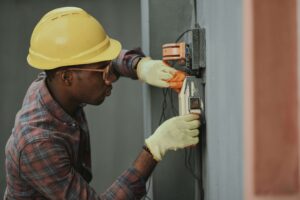
by Emmanuel Ikwuegbu (https://unsplash.com/@emmages)
Don’t
- Open the panel, tighten wires, or test live wiring yourself
- Assume new LED bulbs will fix it. They won’t change the voltage dip.
- Ignore a dim that gets worse, spreads, or comes with a smell or noise
When to Call a Professional
- The dimming is strong or happens at every start
- Some lights get brighter while others dim
- You notice buzzing, burning smells, hot outlets, or tripped breakers
- It started after a new AC or electrical work
- It gets worse over time
Common Questions
Is it normal for lights to flicker when the AC starts?
A brief dim can be. Strong, long, or whole-house flicker is worth checking.
Can a bad capacitor cause it?
It can make the compressor start harder, which can worsen the dip. A technician can test it.
Do I need a new electrical panel?
Not necessarily. An electrician has to check connections and sizing before anyone recommends one.
Who do I call first?
If it comes with buzzing, burning smells, or brighter and dimmer lights, call an electrician. If it’s a dim at startup with a noisy or struggling AC, call an HVAC technician first.
If you’re in the Philadelphia area and your AC seems to be struggling to start, Cool Aid Co. can check the AC side. Wiring, panel, or meter problems need a licensed electrician or your utility.