
How to light a pilot light on a furnace
How to light a pilot light on a furnace?
First, find out which kind of furnace you have — the instructions are completely different.
- Standing pilot: a small flame burns continuously and relights the burners each cycle. If it’s out, you relight it manually. Covered below.
- Electronic ignition (hot surface igniter or intermittent pilot): there’s no continuous flame to relight. The furnace ignites itself electronically each time it calls for heat. If it’s not lighting, the cause is different — skip to Electronic Ignition Furnaces below.
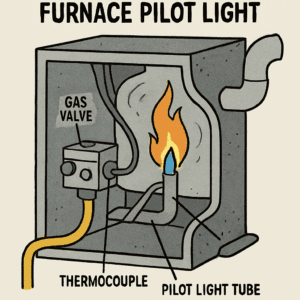
If you’re not sure which you have, look through the access panel. A standing pilot furnace has a small, always-present flame near the burners (when working) and a gas valve with Off/Pilot/On positions. If you see no flame at all, even when the furnace is running normally, you likely have electronic ignition.
Lighting a Standing Pilot
Before you start: turn the furnace off, and make sure the area is ventilated. If you smell gas at any point, stop, leave the house, and call your gas utility — don’t attempt to light anything.
- Remove the access panel to reach the gas valve and pilot assembly.
- Turn the gas control knob to Off and wait about 5 minutes for any residual gas to clear.
- Turn the gas control knob to Pilot.
- Press the knob in and hold it down — this is the knob itself, not a separate button on most residential furnaces.
- While holding it in, light the pilot with a long lighter or match, aiming at the pilot opening.
- Keep holding the knob in for 30-60 seconds after the flame catches. This gives the thermocouple time to heat up and signal that it’s safe to keep the gas flowing. Release too early and it’ll go out.
- Once it stays lit on its own, release the knob and turn it to On.
If it won’t stay lit after a couple of tries, don’t keep repeating the process — move to the troubleshooting section below.
Checking the Flame
- Blue and steady: normal, healthy combustion.
- Yellow, orange, or flickering: incomplete combustion, often from a dirty pilot assembly or a draft. Worth having checked even if it’s still technically working.
- Doesn’t fully engulf the thermocouple: the thermocouple won’t heat properly, and the pilot may keep going out even though it lit successfully.
Why the Pilot Won’t Stay Lit
| What you’re seeing | Likely cause |
| Lights, then goes out within seconds | Failing thermocouple — it can’t confirm the flame is lit, so the safety valve closes |
| Lights, burns for a while, then goes out | Draft — check for nearby open windows, vents, or duct leaks near the furnace |
| Won’t light at all, or lights very weakly | Dirty or clogged pilot orifice |
| Lights fine but flame is yellow | Dirty pilot assembly or a combustion air issue |
A failing thermocouple is one of the most common reasons a pilot won’t hold — it’s an inexpensive part, but testing and replacing it safely is a technician job.
Electronic Ignition Furnaces {#electronic-ignition}
If your furnace uses electronic ignition, there’s no pilot to light manually — the system handles ignition itself every time it calls for heat, either with a hot surface igniter (a glowing element) or an electronic spark. If it’s not producing heat, the cause is almost always one of these instead:
- Hot surface igniter failed — these are fragile and wear out over time, similar to a light bulb. A technician can test and replace it.
- Flame sensor dirty or failing — the furnace may ignite briefly and then shut off because it can’t confirm the flame.
- Control board fault — less common, but can prevent the ignition sequence from starting at all.
None of these are something to troubleshoot by trying to manually “light” anything — there’s no pilot flame to light, and attempting to force one is not how these systems work. This is technician territory.
When to Call a Professional
- The pilot won’t stay lit after a couple of careful attempts
- You smell gas at any point — stop immediately and call your gas utility from outside
- You have electronic ignition and the furnace isn’t producing heat
- The flame is consistently yellow rather than blue
- You’re not comfortable working around the access panel of a gas appliance
Preventing Pilot Light Problems
- Schedule an annual furnace inspection, ideally before heating season
- Keep the area around the pilot assembly clean and free of dust
- Replace the furnace filter regularly — airflow issues can contribute to drafts near the pilot
- Address a flickering or yellow flame promptly rather than waiting for it to go out entirely
Common Questions
How do I light a furnace pilot light?
Turn the gas knob to Pilot, hold it in, light the flame, and hold for 30-60 seconds before releasing. Full steps above.
What if the pilot light won’t stay lit?
Most often a failing thermocouple or a draft. See the troubleshooting table above — if it keeps happening after a couple of tries, that’s a technician visit rather than something to keep repeating yourself.
Why is the pilot flame yellow instead of blue?
Incomplete combustion, usually from a dirty pilot assembly or insufficient combustion air. Worth having checked even if the furnace is otherwise working.
Where is the pilot light on a furnace?
Usually behind the lower access panel, near the burners. Look for the gas control valve with Off/Pilot/On positions nearby.
My furnace won’t light and I don’t see a pilot flame anywhere — is something wrong?
Possibly not with the pilot — you may have electronic ignition, which doesn’t use a standing pilot at all. See the electronic ignition section above.