
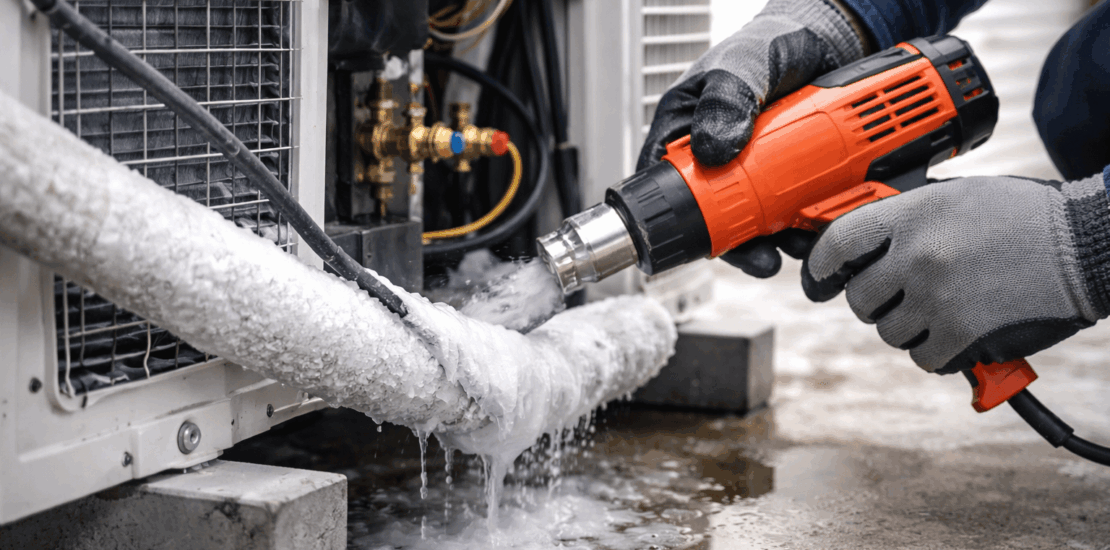
Fixing Frozen Air Conditioner Outside Unit Pipe
Air Conditioner Pipe Frozen Outside? Here’s How to Fix It
Quick fix: Turn the system off completely (not just the thermostat — flip the AC off so the fan stops pulling air across the ice) and let it thaw for 2–4 hours before touching anything else. While it thaws, check your air filter — a clogged one is the single most common cause. Once thawed, replace the filter, clear debris from around the outdoor unit, and restart. If it refreezes within a day, the cause is refrigerant, not airflow, and needs a technician.
That’s the short version. Here’s how to actually diagnose it instead of guessing, because “frozen pipe” can mean a couple of different things depending on which pipe you’re looking at.
Two Pipes, Two Different Meanings
Your outdoor unit has two copper lines running to it, and they don’t do the same job — which matters, because which one is frosted over changes what’s actually wrong.
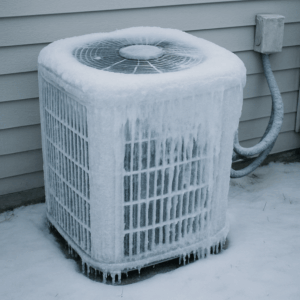
- The big pipe (suction line) — usually wrapped in black foam insulation, roughly ¾” to 1″ thick. This carries cool refrigerant gas back toward the compressor. A little light condensation or sweating on this line in humid weather is normal. Heavy ice or frost coating it is not — that points to restricted airflow or refrigerant that’s too low.
- The small pipe (liquid line) — bare copper, thinner, usually uninsulated. This carries warm liquid refrigerant toward the evaporator coil, so under normal operation it should feel warm to slightly cool, never cold enough to frost. If the small line is icy, that’s a clearer signal of a real problem — almost always a restriction somewhere in the system or a meaningfully low refrigerant charge, since this line has no business being cold enough to freeze at all.
If you’re not sure which is which: the insulated one is the big one. If you only remember one thing from this section, remember that — ice on the insulated line during a humid week is worth watching; ice on the bare, uninsulated line is worth calling someone about sooner.
Why This Happens
All three causes below usually trace back to the same mechanism: the evaporator coil gets colder than it’s designed to, and moisture in the air freezes onto the coil and the lines connected to it. What causes that coil to over-cool differs:
Restricted airflow. A dirty filter or blocked vents mean less warm air moves across the evaporator coil. Less airflow means less heat gets absorbed into the refrigerant, so the coil runs colder than normal — cold enough to freeze the moisture around it. This is the most common cause and the cheapest to check.
Low refrigerant. If refrigerant is low — almost always from a leak somewhere in the system — pressure inside the coil drops, and low pressure lets the remaining refrigerant get abnormally cold. This is also why the liquid line freezing specifically points here: refrigerant that should stay warm on that line is instead cold enough to frost, which is a stronger tell than the suction line icing over.
Dirty coils. Dust and grime on the evaporator or outdoor condenser coil insulate them just enough to disrupt normal heat transfer. The system compensates by running the coil colder to try to hit its target temperature, and ice builds from there.
These aren’t mutually exclusive — a dirty filter often leads to a frozen coil, which strains the system further, which can eventually contribute to refrigerant issues too if left running. That’s part of why step one below is always to turn the system off rather than let it keep working through it.
Also Read: Ac unit is running but not blowing cold air
Step-by-Step Fix
- Turn off the AC completely — at the thermostat is not enough; switch it off at the breaker if you can, so the blower fan stops running too. Running the fan over ice pulls in warm, humid air and just adds to the problem.
- Let it thaw fully before doing anything else. Depending on how much ice has built up, this takes 2–4 hours. Don’t chip at the ice or use a heat source (hair dryer, hot water) to speed it up — you risk damaging the coil or the lines.
- Watch for water while it thaws. Melting ice produces more water than the condensate drain is built to handle all at once, especially if there’s a lot of ice. Put towels or a shallow pan near the indoor unit if it’s accessible, since overflow here is a common cause of the water damage people associate with a “frozen AC” — not the ice itself, but the meltwater afterward.
- Check and replace the air filter. Hold it to a light — if you can’t see light through it, that’s very likely your answer.
- Clear the outdoor unit. Remove leaves, grass clippings, and debris from around the condenser, and confirm nothing is blocking airflow within a couple feet of it.
- Check that vents and registers are open throughout the house — closed or blocked vents restrict airflow the same way a dirty filter does.
- Restart the system once everything above is done and the coil has fully thawed.
- Watch it over the next 24–48 hours. If it stays running without refreezing, the cause was airflow-related and you’ve fixed it. If ice returns within a day or two, the airflow fixes didn’t address the real problem — move to refrigerant.
Also Read: Why is my outside ac unit not running?
When It’s Refrigerant, Not Airflow
If you’ve replaced the filter, cleared the outdoor unit, confirmed vents are open, and it still refreezes, refrigerant is the likely cause — specifically a leak, since refrigerant doesn’t get “used up” during normal operation the way fuel does. A few supporting signs:
- Hissing sound from the outdoor unit
- The small (liquid) line specifically was the one frosted, not just the big insulated one
- Noticeably weaker cooling even before the freeze started
This isn’t a DIY repair. Finding and sealing a leak, then recharging the system, requires EPA certification to handle refrigerant legally, plus the tools to pressure-test the system properly. Topping off refrigerant without fixing the leak just delays the same freeze from happening again.
Preventing It From Happening Again
- Replace the air filter every 60–90 days
- Keep at least 2 feet of clearance around the outdoor unit, clear of plants, leaves, and debris
- Have the coils professionally cleaned once a year, ideally before cooling season starts
- Get refrigerant levels checked annually — catching a slow leak early is far cheaper than dealing with a full freeze-up later
- If you’ve had this happen more than once in a season, don’t just keep re-thawing it — that’s usually a sign of a leak that needs to be found, not a coincidence
by NOAA (https://unsplash.com/@noaa)
Also Read: Why Does My AC Keep Freezing Up? – Causes & Quick Fix
When to Call a Professional
Call a technician if any of these apply:
- It refreezes within a day or two of you clearing the airflow issues
- You hear hissing from the outdoor unit
- The small, uninsulated line is the one that’s frosted
- This has happened more than once this season
If you’re in the Philadelphia area and dealing with recurring freeze-ups, the humidity here adds extra strain on systems that are already running low on refrigerant or airflow, which is often why the same fix doesn’t hold for long. Cool Aid Co. can diagnose whether it’s airflow, refrigerant, or something else, and fix it so it doesn’t come back.