
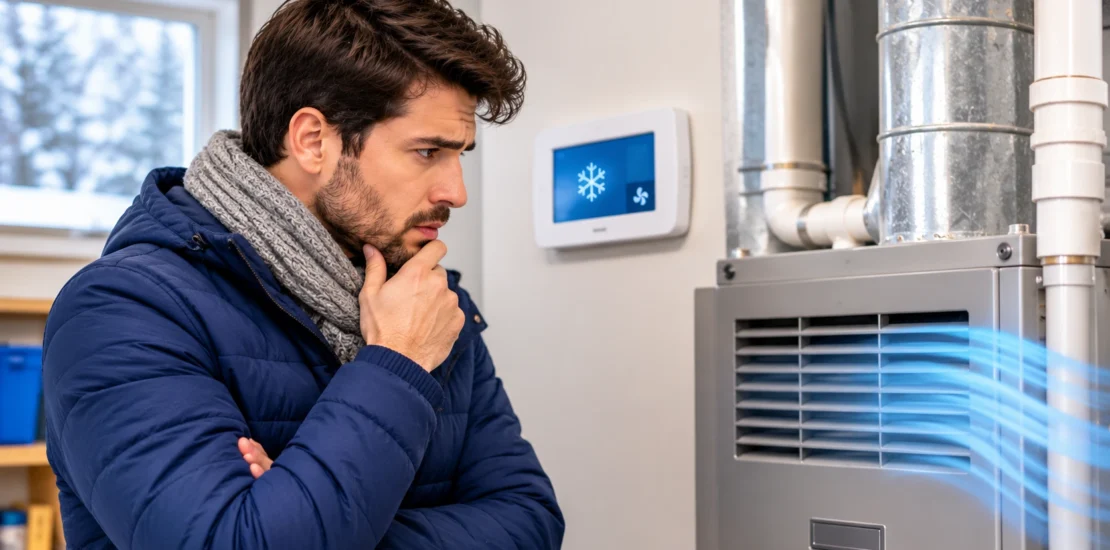
Should I run my furnace fan continually during the winter?
Should I run my furnace fan continually during the winter?
Winter is here, and one of the most common questions homeowners ask is whether the furnace fan should run all the time or only when the heat is on. The answer depends on your home, your comfort needs, and your budget. This guide explains what the furnace fan does, the benefits and drawbacks of running furnace fan continuously in winter, when to use “Auto” or “On,” and how often your furnace should run during the cold months.
What Does the Furnace Fan Do?
The furnace fan, also called the blower, is the part that moves air through your home. When your thermostat calls for heat, the burner heats up, and the blower pushes that warm air through the ducts and out of your vents. The fan also pulls air back through your return vents, so air keeps circulating.
Your thermostat usually has two fan settings:
- Auto: The fan runs only when the furnace is actively heating or cooling.
- On: The fan runs all the time, even when the furnace is not heating.
Deciding whether to set your furnace fan on or auto in winter depends on your home’s air circulation needs and how much you want to save on energy costs.
Should You Run Your Furnace Fan All the Time: Key Benefits
Running the fan nonstop has several advantages, especially for certain households.
More even temperatures. When the fan runs constantly, it mixes air throughout the house. This helps reduce hot and cold spots, especially in multi-story homes or rooms far from the thermostat.
Better air quality. Continuous airflow passes air through the filter all the time. This captures dust, pollen, pet hair, and other particles more often, which can help people with allergies or asthma.
Less humidity buildup in some homes. Moving air can help reduce pockets of stale, damp air, which may lower the risk of mold in certain areas of the house.
Quicker response. Warm air from the furnace is spread more evenly, so rooms may feel comfortable sooner.
Support for ventilation. Research on residential ventilation notes that central air handler fans can be used for whole-house ventilation, which is one reason continuous fan operation is sometimes recommended.
Also Read: Clicking Noise From Furnace
Drawbacks of Running the Furnace Fan Continuously
Running the fan all the time also has downsides.
Higher electricity use. The blower motor uses power every minute it runs. Over a long winter, this can add noticeably to your electric bill, although the increase is usually modest with newer, efficient motors.
Extra wear on parts. More hours of use means that the fan motor, belts, and bearings can have a shorter lifespan before needing repair.
Cold air blowing from vents. When the burner is off, the fan pushes room-temperature or cooler air through the vents. This can feel drafty and uncomfortable, especially near windows or on upper floors.
Dust redistribution. Constant airflow can stir up dust that has settled in ducts, which may be noticeable if the filter is dirty or the ducts are not clean.
Motor Type Changes the Answer
The single most important factor in the cost of running the fan continuously is the blower motor type.
- Older PSC (permanent split capacitor) motors use more electricity at low speeds, which is the speed used for continuous circulation.
- ECM (electronically commutated motor) and other variable-speed motors can run at low speeds with far less power.
Practical rule: If your blower is an ECM or other variable-speed motor, continuous “On” operation is much more affordable. If you have an older single-speed PSC motor, “Auto” is usually the lower-cost choice.
How to check your motor type: Look at the blower motor label or the furnace nameplate, or ask your technician. A technician can confirm this in minutes.
Also Read: Furnace Not Turning On Automatically
When to Use Furnace Fan on or Auto in Winter
Depending on your situation, choose the correct setting.
Use Auto when:
- Your blower is an older single-speed PSC motor, and electricity costs are a concern.
- Your home heats evenly, and you do not notice significant hot or cold spots.
- You are sensitive to drafts from the vents.
- You want the lowest possible electricity use.
Use On when:
- Your blower is an ECM or variable-speed motor, which uses little power at low speed.
- Some rooms are noticeably colder than others.
- A household member has allergies, asthma, or sensitivity to dust, and you are using a higher-efficiency filter that your system can handle.
Should you run your furnace fan all the time? Well, a helpful middle ground is to keep the fan on Auto for most of the day and switch to On for a few hours when the house needs better circulation, such as during a cold morning or when guests are visiting.
Also Read: Where is my furnace exhaust vent
Filters and Indoor Air Quality
The filter is the link between the fan setting and air quality. A clogged filter restricts airflow whether the fan is on Auto or On.
What the U.S. Environmental Protection Agency (EPA) says:
- The most effective ways to improve indoor air are to reduce or remove pollutant sources and to ventilate with clean outdoor air. Upgrading the furnace filter can supplement those steps.
- Central furnace filters are designed to filter air throughout the home, but they cannot remove all pollutants.
- Medium-efficiency filters are generally less expensive than HEPA filters and allow quieter fan operation and higher airflow because they have less airflow resistance.
- Higher-efficiency filters (MERV 14 to 16) are sometimes confused with HEPA filters. True HEPA filters are normally not installed in residential HVAC systems.
- EPA’s wildfire smoke guidance recommends high-efficiency HVAC filters preferably rated MERV 13 or higher when filtration is needed for smoke.
Caution on upgrades: EPA’s Indoor airPLUS technical bulletin notes that higher-MERV filters tend to restrict airflow, so an upgrade should be checked against your system’s design. Before moving to a higher MERV rating, ask a technician whether your blower can handle the added resistance.
Filter replacement: The DOE’s Home Energy Checklist advises cleaning or replacing filters in your furnace, air conditioner, and heat pump on a regular basis.
How Often Should Furnace Run in Winter?
Many homeowners worry that their furnace runs too much or too little. In reality, a furnace should cycle on and off as needed to keep your home at the set temperature. In very cold weather, it may run for long stretches. On mild winter days, it may run only a few times.
A few general guidelines:
- Normal cycling: A furnace usually runs in cycles of about 5 to 15 minutes. Longer “on” times are normal in very cold weather.
- Constant running: If your furnace is constantly running for hours on end, even on mild days, that can point to several potential problems with the heating system. The furnace may be undersized, the filter may be clogged, or the thermostat may be poorly placed.
- Frequent short cycles: If the furnace turns on and off every few minutes, this is called short cycling. It can wear out parts faster and should be checked by a professional.
Keep in mind that the fan setting and the furnace run time are different. Your furnace burner cycles based on the temperature you set, while the fan setting controls only whether the blower runs between heating cycles.
Also Read: Pressure switch stuck open on furnace
Tips for Running Your Furnace Efficiently in Winter
Heating can account for almost half of the average household’s winter energy bill, according to the DOE. These steps help keep the system efficient, whatever the fan setting:
- Replace or clean the filter on the schedule described in Section 6.
- Keep supply vents and return grilles clear of furniture, rugs, and drapes. Blocked registers make the furnace work harder.
- Use a programmable or smart thermostat to set back temperatures on a schedule. The DOE’s Energy Saver guidance recommends programmable thermostats for this purpose. A state energy office notes that the thermostat can be set about 8 to 10 degrees lower when the home is unoccupied.
- Seal drafts around doors and windows.
- Have the heating system inspected before the heating season. Both the CDC and the DOE recommend annual professional service.
- Keep the thermostat clear of drafts and heat sources so it reads the room temperature accurately.
When to Call a Professional
There are emergencies sometimes. Within days, a technician is needed. A routine service is a scheduled task.
Emergency: Call 911 or leave the home first
- Anyone in the home has a headache, dizziness, nausea, confusion, or weakness, especially if several people feel ill at the same time or symptoms improve outdoors.
- A carbon monoxide detector alarms, or you suspect a CO leak.
- You smell gas or notice a burning odor from the furnace.
- You see soot or scorch marks around the furnace, or the furnace flame looks yellow or orange rather than steady blue.
Urgent: Call a technician the same day
- The furnace will not ignite, shuts down repeatedly, or will not stay lit.
- The blower runs continuously, but the house does not warm up at all.
- You hear grinding, squealing, banging, or other loud new noises.
- The furnace switches on and off every few minutes (short cycling).
- The circuit breaker for the furnace trips repeatedly.
- Water is leaking from the furnace, the air handler, or the condensate line.

How COOL-AID CO. Can Help
Not sure which fan setting is right for your home? COOL-AID CO. can inspect your furnace, check your blower motor and filter, and recommend the setting and maintenance plan that fits your comfort needs and budget. If your furnace is running too often or too little, our technicians can find the cause and fix it quickly.
Stay warm and save energy this winter. Contact COOL-AID CO. today to schedule a furnace checkup and get expert advice on keeping your home comfortable all season long.