
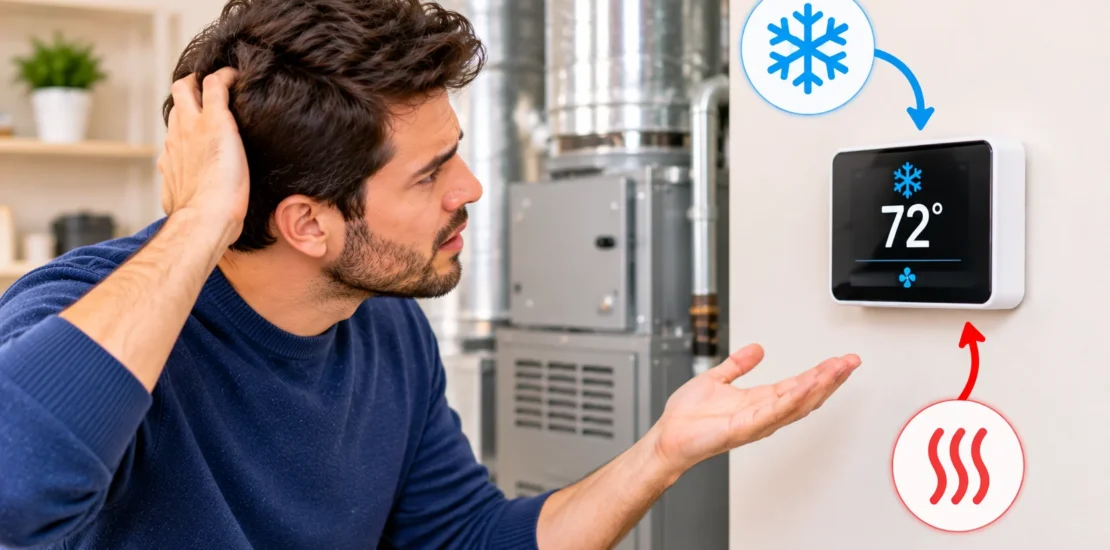
Why Furnace Heats When AC is ON?
Why Furnace Heats When AC is ON?
You switch your system to cooling on a warm day, and then you notice warm air coming from the vents. That is confusing, and it is also a sign that something in your heating and cooling system needs attention. The good news is that this problem usually has a clear cause. This guide explains why it happens, answers the common question of whether the furnace controls the AC, and shows you what to check and when to call a professional if your furnace heats when AC is on.
Quick Answer
A conventional furnace should not be producing heat while the thermostat is set to Cool. If warm air comes from the vents during cooling, the cause is one of a few things: a control or wiring problem, a stuck or failed component, a thermostat mode setting, a heat pump operating in a backup or defrost mode, or an air conditioner that is not cooling and is making the air feel warm. Because some of these causes involve gas-burning equipment, treat unexpected heat from a furnace as a potential safety issue, not only a comfort problem.
Does the Furnace Control the AC?
Your furnace and your air conditioner are separate pieces of equipment, but they share parts of the same system. The furnace houses the blower fan, which pushes air through your ducts whether the air is being heated or cooled. The air conditioner’s outdoor unit (the condenser) and its indoor evaporator coil are the parts that actually remove heat from your home.
The control center is referred to as the thermostat. It communicates with both the furnace and the AC to determine when each one should operate. In a normal setup, when you place the stat into “Cool,” the stat calls the AC and the blower but does not call the furnace burner. Thus, if cooling mode is producing heat, the furnace is not designed to produce heating at the time. There is a wrong signal somewhere, or the system is not doing what it is supposed to do.
Also Read: Furnace not turning on automatically
Reasons Why the Furnace Heats When the AC Is On
1. Wiring Problem at the Thermostat
Thermostat wires are color-coded, and each wire controls a specific function. If the wires are connected to the wrong terminals, or if two wires are touching, the thermostat can send a heat signal when you ask for cooling. This often happens after a thermostat is replaced or a technician has worked on the system.
2. Issue in Thermostat
A faulty thermostat may issue wrong signals. Many older mechanical thermostats and some digital ones can develop problems over time. A malfunctioning thermostat may be the culprit if the display is flickering or erratic, or the thermostat is acting strangely.
3. Stuck or Failed Relay or Control Board
Your system uses relays, or a control board switch, to activate the furnace and the AC unit. When you switch to cooling, if a relay, however, sticks closed, the heat circuit will continue functioning. An electric spark can occur due to poor wiring.
4. Heat Mode is Selected or Confusion in Auto Mode
The thermostat may be set to “Heat” or “Emergency Heat” without you knowing it. When left in Auto mode, the unit alternates between heating and cooling as needed, and in AC season the temperature may feel like the furnace is on. Check the initial mode setting in such a case.
5. Heat Pump Defrost or Reversing Valve Issues
If your house uses a heat pump instead of a furnace and AC, the unit could be operating differently. A reversing valve problem or defrost cycle issue can cause warm air when it should be cooling. A technician will have to check this.
The American Society of Heating, Refrigerating and Air-Conditioning Engineers (ASHRAE) standard for heat pump controls states that auxiliary heat should energize only when the heat pump has insufficient capacity to maintain the set point and that controls should prevent supplemental heater operation when the heat pump alone can meet the load.
6. Ductwork Problems
Ducts that are leaky or not connected properly can pull in hot air from attics, crawl spaces, or sunny rooms. It may feel warm inside because the AC is not equipped to deal with this. Verify if the warm air is most powerful near the vents in certain rooms or one.
The Department of Energy and ENERGY STAR both document significant duct losses:
- ENERGY STAR reports that about 20 to 30% of the air moving through a typical duct system is lost to leaks, holes, and poorly connected ducts.
- DOE research describes duct leakage that can draw attic air into the living space, which increases cooling loads and affects comfort.
- Leaky ductwork in a heating and cooling system may also cause back drafting, where combustion gases from gas appliances are drawn back into the home instead of venting outside.
Duct issues are probably responsible if warm air is strongest in rooms not close to the equipment or the ducts run through an attic. Duct leaks have safety implications because of backdrafting risk, not just efficiency ones.
7. Air Conditioner Not Cooling Properly
AC units can fail to cool properly if they have low refrigerant charge or if the condenser coil is dirty. What comes out may feel warm—one might mistake this for the furnace heat. Make sure that the outdoor unit is running and that the air from the vents is cooler than the room.
8. Blower Running on Heat Setting After Cooling
Some systems run the blower briefly after the AC has been shut off. It’s normal for the fan to remain off for some time, and if the air is warm during this time, it is the leftover heat of the coil/duct system. It should go away in a few minutes.
Simple Checks You Can Do Safely
Try these simple steps before calling a pro:
- Confirm the thermostat mode. Check that thermostat mode. Ensure that it is set to “Cool,” not “Heat” or “Emergency Heat.”
- Check the temperature setting. Set it several degrees below the current room temperature and wait five minutes.
- Check the air filter. A clogged filter reduces airflow and can make cooling less effective.
- Look at the outdoor unit. Is the fan spinning? Is the unit free of debris, leaves, and dirt?
- Feel the air at the vents. Cool air should come out within a few minutes of starting the AC. Warm air that persists may point to a wiring or equipment problem.
- Reset the thermostat. Turn it off for a minute, then turn it back on in cooling mode.
Do not open the furnace panel or touch wiring if you are not trained to do so. Electrical parts can carry dangerous voltage even when the system seems off.
A furnace that operates inadvertently, as well as leaky ducts that cause back drafting, can raise CO risk. A gas furnace may not work if you detect unusual warmth along with an unusual smell or any symptoms. Treat this as a safety issue.
Also Read: Running furnace fan continuously in winter
When to Call a Professional
Emergency: Leave the home and call 911
- Anyone in the home has headache, dizziness, nausea, confusion, or weakness, especially if several people feel ill at the same time or symptoms improve outdoors.
- Carbon monoxide alarm sounds an alert.
- If you smell gas or burning, alert us.
- The presence of burn marks, soot or a furnace that won’t stay lit is one of the furnace problems that you should note.
Urgent: Turn off the system and call a licensed technician promptly
- The furnace is heating while the thermostat is set to cool.
- Warm air continues after you have checked the thermostat mode, filter, and settings.
- The air conditioner runs, but the supply air is warm or only slightly cool.
- You hear buzzing, clicking, grinding, or other unusual sounds from the equipment.
- The system short cycles, turning on and off repeatedly.
- Auxiliary (emergency) heat stays on continuously on a heat pump.
- The circuit breaker trips repeatedly.
Routine: Schedule service within a few weeks
- Warm air appears only in certain rooms, suggesting ductwork problems.
- The system is due for its annual inspection. The Centers for Disease Control and Prevention (CDC) recommends annual professional service for heating and cooling equipment.
- You want the ductwork tested for leakage, especially if it runs through an attic or crawl space.
- You are unsure whether your system is a furnace and AC or a heat pump
Also read: Heil Furnace Only Works With Door Off
Prevention and Maintenance
These practices reduce the chance of cooling and heating problems:
- Schedule annual professional inspections of both the heating and cooling systems before each season.
- Replace or clean filters on a regular schedule. Clean or replace filters in furnaces, air conditioners, and heat pumps annually.
- Keep the outdoor AC coils clean and clear of debris.
- Seal and insulate ducts, especially in unconditioned spaces.
- Install and maintain CO detectors on every level of the home.
- Keep vents and returns unblocked by furniture and drapes.
Conclusion
The thermostat wiring, faulty relay or control board, a mode setting, or a cooling issue can all cause the air coming from the furnace to impact the air being produced by the AC. If it’s warm, it might be heating. A cooling mode should not activate the furnace. If your furnace is overheating in cooling mode, it is a sign to call for service. If the problem persists after performing these simple checks, please contact COOL-AID CO. Our technicians can find the exact cause, safely make the repair, and help your home stay comfy all summer long.